Imagem do banner sem descricao

Decarbonization for Businesses, Industries, and Events

Discover how to align sustainability with your business strategy through greenhouse gas emissions offsetting.

Descarbonization means aligning sustainability with business goals

Descarbonization  is much more than an ESG agenda. Today, it influences access to different markets aligned with regulatory requirements and climate goals.


Descarbonization means reducing and offsetting the greenhouse gas emissions generated by a company's or event's activities. This journey involves identifying the main sources of emissions, implementing reduction measures, using renewable energy, and monitoring results over time.


More than an environmental initiative, descarbonization has become a business strategy, helping organizations meet regulatory requirements, strengthen brand reputation, and enhance their competitiveness.

Placeholder

The path to a low-carbon operation

homem mexendo no computador

Measure Emissions

The first step is to map your operation’s climate impact through a greenhouse gas (GHG) emissions inventory. This initial assessment helps identify emission sources and map Scope 1, Scope 2, and Scope 3 emissions.

Benefits of the descarbonization journey

  • 1
    Ícone por nome (compatibilidade; a imagem tem prioridade) Texto de exemplo
    Meet market expectations

    Customers, investors, and business partners are increasingly focused on climate goals and value chain emissions.

  • 2
    Ícone por nome (compatibilidade; a imagem tem prioridade)
    Access new markets

    Exporters and suppliers must meet growing requirements related to carbon emissions.

  • 3
    Ícone por nome (compatibilidade; a imagem tem prioridade) Texto de exemplo
    Reduce risks and improve efficiency

    Emissions management helps identify opportunities for operational improvement, energy efficiency, and waste reduction.

  • 4
    Ícone por nome (compatibilidade; a imagem tem prioridade) Texto de exemplo
    Strengthen ESG strategy

    Tracking climate-related indicators enables organizations to demonstrate progress and transparency to stakeholders.

The next step is turning strategy into results
Imagem de fundo do container Imagem de fundo do container
Visão da plataforma METRIA

METRIA

Organizations advancing their climate goals need clear visibility into results, performance indicators, and opportunities for improvement.

With METRIA, your organization can track the progress of its descarbonization journey in a single environment, transforming data into faster, more strategic decisions.

METRIA offers solutions for Scopes 1, 2, and 3

Scope 1

These emissions come from sources that are owned or directly controlled by your organization.

To offset these emissions, you can rely on our Carbon Credits solutions.

Scope 2

Scope 2 emissions are indirect and result from your organization's energy consumption.

To offset these emissions, you can purchase Renewable Energy Certificates (RECs).

Scope 3

Scope 3 emissions are indirect and occur across the entire value chain of your organization.

To offset these emissions, you can also rely on our Carbon Credits solutions.

Access the METRIA platform

Descarbonization highlights with AXIA

Imagem sem descrição

Rock in Rio

AXIA and Rock in Rio 2026 Commit to Decarbonizing 100% of the Festival Experience, Including Operations and Fan Travel.

Imagem sem descrição

SP2B

AXIA and SP2B Partner to Decarbonize One of Brazil’s Largest Innovation Events, Held from August 9 to 16, 2026, in São Paulo.

Imagem sem descrição

Brazilian Energy Leaders Forum

AXIA fully neutralized the carbon emissions generated by the event, which took place on March 26 and 27, 2026.

Imagem sem descrição

Flamengo

AXIA and Flamengo Advance Sports Decarbonization Through the Neutralization of Electricity Consumption at the Club’s Headquarters Between 2024 and June 2025.

Stay informed

Frequently Asked Questions

  • Measure

  • Plan

  • Reduce

  • Track Results

Any organization can begin a decarbonization journey, regardless of its size or industry.

Companies, manufacturers, retailers, service providers, event organizers, logistics operators, and public institutions can measure, reduce, and monitor their greenhouse gas (GHG) emissions. The process is particularly relevant for organizations with ESG goals, sustainability commitments, customer requirements, or the need to report environmental performance indicators.

An emissions inventory is the process of identifying, calculating, and recording the greenhouse gas (GHG) emissions generated by an organization.

It enables organizations to understand their main emission sources, quantify climate impacts, and establish a foundation for decarbonization strategies.

Methodologies such as the GHG Protocol are widely used to structure and standardize this assessment.

A carbon footprint is the total amount of greenhouse gas emissions generated directly or indirectly by an activity, product, event, or organization.

Usually expressed in tonnes of CO₂ equivalent (tCO₂e), it is used to assess environmental impacts and guide emission reduction initiatives.

Greenhouse gases are substances in the atmosphere that contribute to global warming by trapping heat. The main GHGs include carbon dioxide (CO₂), methane (CH₄), nitrous oxide (N₂O), and fluorinated gases.

Measuring and managing these gases is essential for sustainability and decarbonization strategies.

Scopes 1, 2, and 3 are categories used to classify an organization’s greenhouse gas emissions.

Scope 1 covers direct emissions from operations, such as company-owned vehicle fleets and the combustion of fossil fuels in boilers.

Scope 2 includes emissions associated with the consumption of purchased electricity, steam, heating, or cooling.

Scope 3 encompasses indirect emissions generated throughout the value chain that are not directly controlled by the company, such as supplier transportation, employee business travel, waste generation, and product use.

Calculating emissions typically begins with a greenhouse gas emissions inventory.

Data such as energy consumption, fuel use, transportation, waste generation, and other operational activities are collected. Recognized emission factors are then applied to convert these activities into tonnes of CO₂ equivalent, allowing the organization’s carbon footprint to be measured.

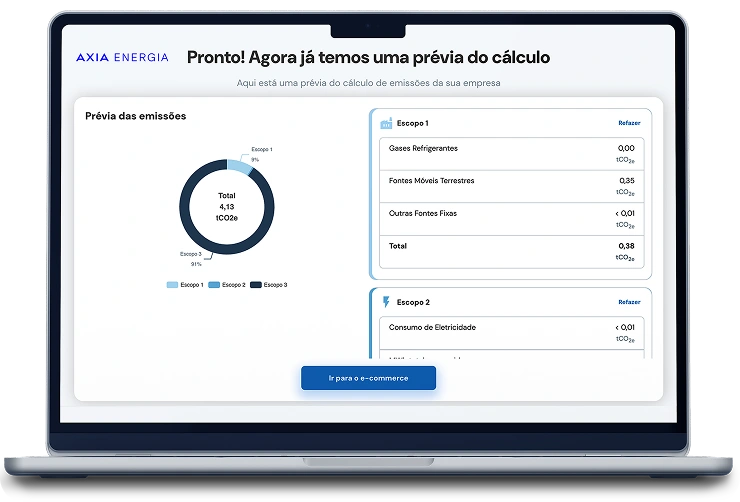
To simplify this process, companies can use METRIA’s carbon calculator. Once data from emission sources is collected, it can be entered into the calculation tool, which assigns values to each source and quantifies greenhouse gas emissions. These calculations are based on the guidelines of the Brazilian GHG Protocol Program, and results are generated immediately.

The first step is to measure the organization’s current emissions through a greenhouse gas (GHG) emissions inventory. This can be done using METRIA’s carbon calculator.

Based on this assessment, organizations can identify opportunities for emissions reductions, set targets, establish performance indicators, and develop an action plan aligned with business objectives. The journey should be continuously monitored to ensure consistent progress, and AXIA Energia can be your partner along the way.

Net Zero means reducing greenhouse gas emissions as much as possible before offsetting those that cannot yet be eliminated. It prioritizes structural changes and emissions reductions across the value chain.

The goal is to achieve a balance where the amount of emissions generated is equal to the amount removed from the atmosphere, helping limit the impacts of climate change.

Being carbon neutral means offsetting or neutralizing an amount of emissions equivalent to those generated by an organization, product, or event that could not be reduced.

This is typically achieved through the purchase of carbon credits or investments in emission removal projects.

Unlike Net Zero, the focus is on neutralizing the total emissions impact.

Carbon neutrality means offsetting generated emissions until a neutral balance is achieved.

Net Zero, on the other hand, prioritizes actual emissions reductions throughout the value chain, using offsets only for residual emissions that are difficult to eliminate. For this reason, Net Zero is considered a broader commitment that is more closely aligned with long-term global climate goals.

Targets should be based on the organization’s emissions inventory, taking into account its most significant sources of impact.

It is important to establish measurable objectives, define timelines, track performance indicators, and periodically review results. Many organizations use frameworks such as the Science Based Targets initiative (SBTi) to align their goals with climate science.

With the support of AXIA Energia, your company or event can receive expert guidance, strategies, and the tools needed to begin reducing emissions.

The investment required varies depending on the size of the organization or event, the complexity of its operations, and its level of sustainability maturity.

In many cases, the journey can begin with relatively simple initiatives, such as emissions inventories, diagnostic assessments, and performance monitoring.

The most important step is to start measuring emissions and building a plan for continuous improvement over time.

With METRIA, companies have free access to a carbon emissions calculator. All they need to do is provide basic registration information and answer a set of questions designed to map the emissions generated by their business.

Reducing emissions means avoiding or decreasing the generation of greenhouse gases through operational improvements, energy efficiency measures, or process changes.

Offsetting emissions means supporting projects that remove or avoid an equivalent amount of emissions elsewhere.

Emission reductions should be the priority, while offsetting typically complements these efforts.

The most common strategies include improving energy efficiency, electrifying processes, increasing the use of renewable energy, optimizing logistics, enhancing waste management, improving industrial processes, and engaging suppliers across the value chain.

The most effective initiatives depend on each organization’s characteristics and emission sources.

The Carbon Market encompasses mechanisms that assign an economic value to the reduction or removal of greenhouse gas emissions. In simple terms, it is a system that enables the trading of carbon credits among countries and organizations.

It is divided into two main types:

  • Compliance Market: Established by governments or regulatory bodies that set emissions reduction targets for companies. Organizations that fail to meet these targets may be required to purchase credits to offset excess emissions.
     
  • Voluntary Market: Driven by companies, NGOs, and individuals that voluntarily choose to offset their emissions. Although not regulated by government legislation, it is generally guided by certification standards established by non-governmental organizations.

Companies and events can purchase carbon credits to offset environmental impacts and support projects that contribute to climate change mitigation.

Carbon Credits are certificates representing the reduction, removal, or capture of one tonne of carbon dioxide equivalent (tCO₂e).

They are part of emissions offsetting mechanisms and are generated by certified environmental projects. Organizations can use them to offset a portion of their emissions, and they function as a form of currency within the carbon market.

Carbon credits are generated by projects that demonstrate the reduction or removal of greenhouse gas emissions, such as reforestation, renewable energy generation, methane capture, and environmental conservation initiatives.

Once certified, these credits can be purchased by organizations seeking to offset residual emissions and strengthen their climate strategies.

Os Créditos de Carbono podem receber diferentes denominações conforme o mercado, o padrão de certificação e a natureza do projeto:

By certificate type:

  • CER (Certified Emission Reduction): Generated under the United Nations’ Clean Development Mechanism (CDM) and linked to the Kyoto Protocol.
     
  • VER (Verified Emission Reduction) or VCU (Verified Carbon Unit): Credits from the voluntary carbon market, typically certified under standards such as VCS (Verra) and Gold Standard.

By project type:

  • REDD+ Credits: Generated from projects focused on Reducing Emissions from Deforestation and Forest Degradation. These projects promote conservation or reforestation of natural areas, where forests act as carbon sinks by absorbing significant amounts of CO₂ from the atmosphere.
     
  • Renewable Energy Credits: Generated from projects that produce energy from renewable sources such as wind, solar, hydropower, and biomass. These projects help reduce greenhouse gas emissions by replacing more carbon-intensive fossil fuel energy sources.
     
  • Carbon Capture and Storage (CCS) Credits: Generated from projects that capture and permanently store carbon emissions.

Renewable energy reduces emissions at their source by replacing fossil fuels with alternatives such as solar, wind, and hydropower.

Carbon offsetting, on the other hand, neutralizes emissions that have already been generated through the purchase of carbon credits.

Both strategies can play an important role in a decarbonization journey, but they serve different purposes.

The main indicators include total greenhouse gas (GHG) emissions, emissions per unit produced, energy consumption, share of renewable energy sources, carbon intensity, Scope 1, 2, and 3 emissions, and progress toward climate targets.

Continuous monitoring makes it possible to assess results and identify opportunities for improvement.

Progress should be tracked through periodic indicators, updated inventories, and management systems that consolidate emissions and sustainability data. This can be done easily with METRIA, AXIA Energia’s web-based platform designed to support this process.

Comparing established targets with achieved results helps guide decision-making and keep the decarbonization strategy aligned with business objectives.

Yes. Carbon credits can be reported in sustainability reports and ESG disclosures, provided they are used transparently and in accordance with the criteria adopted by the organization. It is important to clearly distinguish between emission reduction actions and offsetting initiatives.

After quantifying their emissions, companies and events can acquire carbon credits and RECs to offset emissions from Scopes 1 and 2, or from all three scopes, and disclose these actions in sustainability reports. This increases transparency for stakeholders and reinforces the organization’s commitment to ESG principles.

The best approach is to rely on trustworthy indicators, updated inventories, documented targets, and evidence of implemented actions.

Sustainability reports, independent audits, and monitoring platforms help demonstrate progress, transparency, and sound governance in emissions management.

Centralizing data in a management platform makes it possible to consolidate information from multiple sources, track indicators in real time, monitor climate targets, and generate more consistent reports.

This continuous monitoring increases visibility into the decarbonization journey and supports data-driven decision-making.

That is why, METRIA is an excellent option for organizations looking for a comprehensive decarbonization solution.